
You’ve probably heard the common advice that you should write the introduction to your thesis last. If you follow that advice, you’ll be writing your introduction and conclusion around the same time, and it can be difficult to know what to put where.
It might feel like you are just writing the same overview of your research twice under different headings, so what do you put in the introduction, and what do you put in the conclusion?
The simplest way to differentiate between the intro and the conclusion is to think of the introduction as the state of knowledge prior to your research, and the conclusion as the state of knowledge following your research.
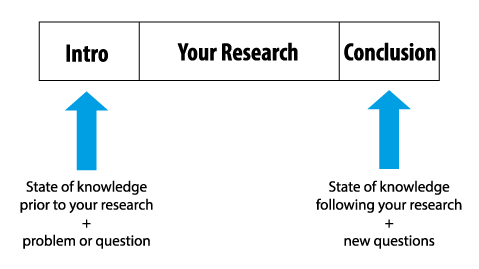
In your introduction, you should outline the problem(s) you are trying to solve and the question(s) you are trying to answer.You should also place those problems or questions in context by describing some broader situation (whether that is a brief summary of research or a “real-world” problem).
This needs to be structured in such a way that it leads the reader towards your research topic, for example;
X is an important issue… Two key problems are A and B… In order to do A and B, we need to understand C… A great deal of recent research into C has focused on the use of variations on method D… however, D is limited in it’s ability to fully assess C… This thesis investigates the potential use of method E
There are many ways to do it, but as a general rule the introduction only needs to go as far as describing the problem. You don’t need to summarize the results; there will be plenty of time for that later.
What do you know now, as a result of your research that wasn’t known before? Why is this significant?
Does your work confirm or contradict other published work?
What questions does your research raise, and is there potential for further research?
Try to keep the conclusion simple, and focus on the most important things you want the reader to remember from your thesis.

PhD: an uncommon guide to research, writing & PhD life is your essential guide to the basic principles every PhD student needs to know.
Applicable to virtually any field of study, it covers everything from finding a research topic, getting to grips with the literature, planning and executing research and coping with the inevitable problems that arise, through to writing, submitting and successfully defending your thesis.

All the text on this site (and every word of every video script) is written by me, personally, because I enjoy writing. I enjoy the challenges of thinking deeply and finding the right words to express my ideas. I do not advocate for the use of AI in academic research and writing, except for very limited use cases.
See also:
